Alumni Spotlight
Chris Kiker, MD
Every story begins at Mercer
This Q&A series highlights the journeys of our graduates as they continue to live out the School of Medicine’s mission of service, compassion and lifelong learning.
A Conversation with Dr. Kiker
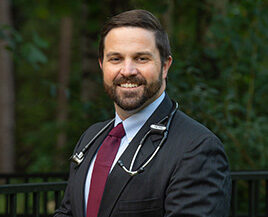
From rural Georgia clinics to international Mercer On Mission trips, Dr. Christopher Kiker’s path reflects a life devoted to healing and service. In this Q&A, he shares the experiences that shaped his calling, how the Nathan Deal Scholarship empowered him to serve where he’s needed most, and what gives him hope for Georgia’s health care future.
Was there a defining moment or experience that confirmed medicine was the right path for you?
I have had several experiences in clinic that have strengthened my calling to serve in rural underserved areas of Georgia. From feeling an enlarged lymph node that turned out to be cancer, to diagnosing late-stage prostate or colon cancers with poor outcomes, these moments stay with me. Each time, I can’t help but think, “If only I had found you sooner.” Earlier detection could have prevented suffering and extended life: a reminder of how deeply access to care matters.
On the other hand, when something is caught early and a solid treatment plan is in place, the story is completely different. Patients look you in the eye and say, “Thank you for saving my life.” Those moments are profoundly meaningful. They remind me why this profession is more than a career, but a calling.
Working in rural Georgia offers both challenge and purpose. The impact is tangible, the relationships are genuine, and the gratitude is deeply felt. These experiences continually reaffirm my commitment to serve where the need is greatest and to bring compassionate, comprehensive care to those who might otherwise go without.
How did the Nathan Deal Scholarship impact your medical education or your ability to serve others in rural underserved Georgia communities?
Maintaining a manageable debt load in your twenties is one of the most important steps toward true financial independence in the later decades of life, no matter your profession.
In medicine, this principle carries even greater weight. Medical education is a significant investment of both time and money, and minimizing debt can profoundly shape a physician’s career path.
For medical students, this financial flexibility opens doors, allowing them to serve where they feel called and to choose primary care or rural medicine without financial pressure. It’s a promise the Nathan Deal Scholarship fulfills—empowering future physicians to serve Georgia’s communities with both purpose and financial stability.
Mercer emphasizes serving rural underserved communities—how has that mission influenced your goals as a physician?
Mercer University School of Medicine’s mission aligns perfectly with my calling in life. It has been a blessing to have a place where I could not only study medicine but also learn how to live out God’s calling for my life.
At Mercer, I was surrounded by people who shared a common purpose: to serve others and to bring healing where it’s needed most. That environment of shared faith, compassion, and commitment shaped me deeply. It allowed me to grow both personally and professionally, preparing me to step boldly into a career devoted to service.
Mercer didn’t just teach me how to practice medicine. It gave me the foundation to pursue medicine as a calling. The mentorship, the sense of mission, and the community I found there helped me leap forward in ways that would not have been possible anywhere else.
Have you had a particular patient or community experience during your training that stands out as especially meaningful?
Every day in medicine, my goal is simple: to create value in my patients’ lives. Creating value often means being skilled and resourceful in the clinic, so patients don’t have to spend extra money on specialty co-pays, take time off work, or travel long distances for specialist visits. Practicing full-scope family medicine allows me to provide a wide range of services, from procedures to chronic disease management, right here in the community.
By limiting unnecessary referrals and keeping care local, we ease both the financial and emotional burdens on patients. Each time I can handle something in the office rather than sending it elsewhere, I know I’ve added real value to that person’s life. That’s what family medicine is about—meeting people where they are, serving them well, and helping them live healthier, fuller lives.
What was the most rewarding part of your undergraduate time at Mercer?
One of my most rewarding experiences I’ve had through Mercer actually happened during my undergraduate years. I had the privilege of participating in Mercer On Mission for two consecutive summers. In 2008, I joined a team on a trip to China. The following year, I traveled to Thailand.
Those experiences profoundly shaped my understanding of service and solidified my calling to serve people through medicine. Being immersed in other cultures and seeing how communities approach health, faith and daily life was truly eye-opening. It’s something that can only be understood by experiencing it firsthand.
When you think about the future of health care in Georgia, what gives you hope?
At its core, health care has always been about the relationship between a patient and a physician. Over time, as our health care system has become more complex, I’ve come to appreciate that this relationship now extends through the entire health care team.
I’m encouraged to see medical schools like Mercer University training physicians who understand that the patient-physician relationship remains the foundation of effective care. Programs like Mercer’s Nathan Deal Scholars are preparing future primary care physicians to lead integrated teams that prioritize evidence-based care and meaningful human connection.
I’m also hopeful when I see the growing emphasis on data-driven best practices and quality-focused population health. These tools help us refine our systems and improve outcomes, yet they work best when they serve human relationships at the center of medicine.
Finally, I’m hopeful that as a society, we continue to explore what it means to live and die well. When we acknowledge that death is as natural as birth, we can create systems that help patients pass gracefully, with dignity and peace.
In the end, health care remains a deeply human endeavor. It’s defined not by technology or policy, but by relationships rooted in trust, compassion and respect.